Claustrophobia
Falling For The CEO: BAD BOY ROMANCEClaustrophobia is Diana Jones's fear of being trapped in enclosed spaces, but the novel gives that fear a significance beyond a situational vulnerability. When an elevator strands her with William King during a hotel-wide power failure, the condition produces dizziness, laboured breathing, and a desperate effort to control attention. Later, the narrative connects her fear of confinement to the deeper fear of being left alone that followed her parents' deaths. Claustrophobia therefore operates simultaneously as a bodily experience, a recurring pressure on Diana's choices, and a spatial image for the emotional insecurity she has not yet learned to outgrow.
Definition and First Crisis
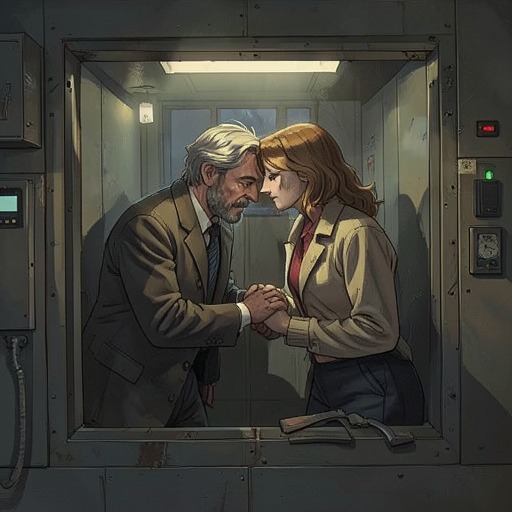
Claustrophobia becomes explicit when the elevator carrying Diana and William stops abruptly and its lights go out. Diana loses her balance, strikes the back of her head, and is lowered to the floor by William's strong arms. At first, the dizziness can be attributed to the blow, but the enclosed darkness quickly exposes the larger cause: the realization that she is trapped in a confined space makes breathing difficult. She identifies the problem directly by admitting, "I'm a little...claustrophobic."
The scene distinguishes ordinary alarm from an involuntary bodily response. Diana tries to regulate herself by inhaling and exhaling slowly, insists that the injury is only a bump on the head, and avoids standing because she does not trust her knees. Her fear is not described as a considered judgment about danger; it arrives through breath, balance, dizziness, and the narrowing of attention. William notices her heavy breathing and responds with concern, while Diana attempts to retain enough composure to avoid appearing helpless.
The Elevator as a Pressure Chamber
The elevator's failure intensifies the condition through a sequence of practical obstacles. William's phone provides only a dim light and no reception, so Diana points him toward the red emergency button on the control panel. The intercom confirms that the entire grid has lost power and that the hotel's generator has also failed; rescue may take up to thirty minutes. The specific duration matters because the crisis is not an instant fright followed by immediate release. Diana must remain inside the elevator while waiting for an uncertain rescue.
Her coping strategy is partly attentional. She tells herself not to focus on the fact that she is trapped, and the easier breathing that follows is conditional rather than secure. She also keeps her distance from William because she does not want to fall into his arms again, even though his presence is simultaneously reassuring and overwhelming. Once he sits beside her, the darkness heightens sensory awareness: she notices his musky scent, hears what seems like the throbbing of her own heart, and attributes the intensity to the elevator's confines. The enclosed space thus turns fear and attraction into competing readings of the same physical symptoms.
The scene also makes claustrophobia relational. William cannot remove the confinement, restore the electricity, or call for help, but he can hold Diana after her fall, ask whether she is all right, illuminate the darkness, activate the emergency system, and remain beside her. His practical care does not cure the fear, yet it changes what being trapped means. The elevator is both a threat and the setting in which Diana begins to experience William as a person capable of staying present while she struggles.
Bereavement and Fear of Abandonment
The novel later places Diana's claustrophobia within the history of her parents' deaths and the depression that followed. Cora Jones is remembered as exceptionally kind and self-sacrificing, while Derek Jones loved her deeply; their marriage becomes part of Diana's emotional model of care. Their deaths in a car crash occurred the day before Diana's final first-year university examination. She insisted on writing the examination, but after the funeral and the descent of the coffins into the ground, denial gave way to a prolonged collapse.
Diana lost a university scholarship and several friendships when she could not return for her second year. Connor Jones intervened by appearing at her house and refusing to leave unless she went to work with him at the hotel. For a month she followed him largely because she felt guilty about keeping him from his job. The work eventually became restorative: she discovered that she enjoyed communicating with guests, advising them about the city, and planning tours. Connor arranged a trial period for the tours, and their popularity allowed her to make them her principal work. Researching Cape Town's history and culture helped her move from merely surviving toward living again.
That recovery remains incomplete. Six years after the deaths, Diana still feels that she has not become fully independent. She is grateful that Connor incorporated her into his life, yet she also recognizes that he eventually resumed his own life once he believed she was safe. Her parents did not abandon her willingly, but their deaths nevertheless left her; emotionally, the distinction does not erase the experience of being left behind. The narrative consequently makes room for two truths at once: Connor's care is real, and Diana's feeling of abandonment is real as well.
Confinement, Work, and Intimacy
Claustrophobia appears alongside Diana's insecurity about her position at the hotel. On a Sunday evening she dreads the following workday, not because of the work itself but because she does not know how long she will retain her job and must continue avoiding William, her boss. The fear of physical enclosure is therefore accompanied by fear of institutional and emotional entrapment: employment gives her stability, while her relationship with William threatens that stability because of the workplace boundary.
After their kiss, Diana's thoughts move between pleasure and alarm. She remembers the tenderness and sexual intensity of the encounter, feels its effect in her still-tingling lips and curling toes, and recognizes that it touched her heart as well as her body. She even allows herself to imagine an ordinary progression from dating to commitment before recoiling from the absurdity of imagining a proposal while she is an employee in William's hotel. Claustrophobia is not named in this later passage, but the same structure persists: desire draws her toward intimacy, while the consequences of remaining inside an unsafe or unstable situation make her want an escape route.
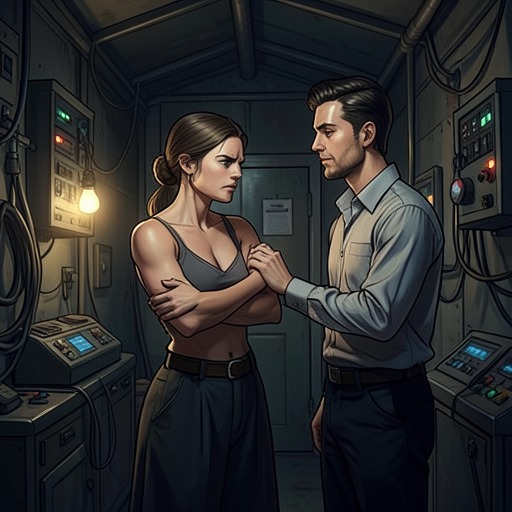
Her confrontation with Connor makes the emotional pattern more direct. When she fears losing her job, she accuses him of having always kept his life in order and of being the person who repeatedly has to save her. She insists that she cannot keep asking him to rescue her and must face possible retrenchment herself. The statement shows how dependence has become both necessary and humiliating for Diana. The elevator scene externalizes that conflict in physical form: she needs William's help after the fall, but immediately guards against needing his arms a second time.
Inherited Models of Leaving and Care
The surrounding family histories give claustrophobia a wider relational context without reducing the condition to a simple diagnosis. Luna Jones, Connor's mother, developed severe highs and lows around the birth of her son and was eventually diagnosed with bipolar disorder. After filing for divorce, she left Connor with Derek Jones and thereafter spoke to him rarely, sometimes only on his birthday if she remembered. Connor's childhood experience of maternal abandonment helps explain why he becomes so family-oriented and why he assumes a protective role toward Diana.
William King describes a parallel wound in his own family. His mother did not want children, became pregnant accidentally, opposed his father's refusal to agree to an abortion, and remained until William was ten before deciding she could no longer continue. He now has little contact with her. His father and stepmother, John King and Gloria, provide the stable family connection he values, while Tara King greets him with energetic affection during the Sunday lunch he had tried to avoid. The family scene shifts his emotional state from turmoil toward guilt and persuades him to acknowledge that he and Diana are on a break.
Gloria identifies the unresolved force beneath William's response to Diana. He believes he has been hurt by Julia, but Gloria argues that he never properly dealt with that pain and has allowed it to govern his treatment of Diana. Her counsel is grounded in her own relationship with John: she describes how his abandonment by William's mother had closed him off until he accepted love again. This family pattern mirrors Diana's fear that people who matter will leave and William's distrust of partners who promise unconditional love. Claustrophobia consequently belongs to a network of inherited and repeated abandonment experiences, even though Diana is the character who experiences the condition physically.
Narrative and Thematic Significance
The elevator episode uses a malfunctioning building to make inner distress visible. Darkness, uncertain rescue, a failed generator, restricted movement, and the absence of phone reception convert psychological fear into an external situation with concrete limits. Yet the scene does not treat the elevator only as a plot device. Its walls concentrate Diana's bodily panic, her attraction to William, her embarrassment about dependence, and her need to control what she notices.
The novel also resists presenting fear as something solved simply by reassurance. Diana manages her breathing, presses the emergency button, waits for rescue, and remains conscious of her symptoms; William offers care, but no one declares the fear cured. The condition is instead shown as a lived experience that can be negotiated through practical action and human presence. Its emotional counterpart remains active later, when Diana recognizes that she is afraid of being alone and of re-entering the feeling produced by her parents' deaths.
In this sense, Claustrophobia gives architectural form to the novel's larger concern with trust. Diana longs for connection but fears the loss of autonomy and the pain that may follow attachment. William wants to believe that love can carry his earlier relationship trauma into the past, while Gloria urges him to acknowledge the hurt rather than let it control him. The confined elevator is the clearest physical image of that dilemma: escape is necessary, but endurance becomes possible only when another person remains close enough to help without pretending that the fear is not there.